Showing posts with label Nature Wallpaper. Show all posts
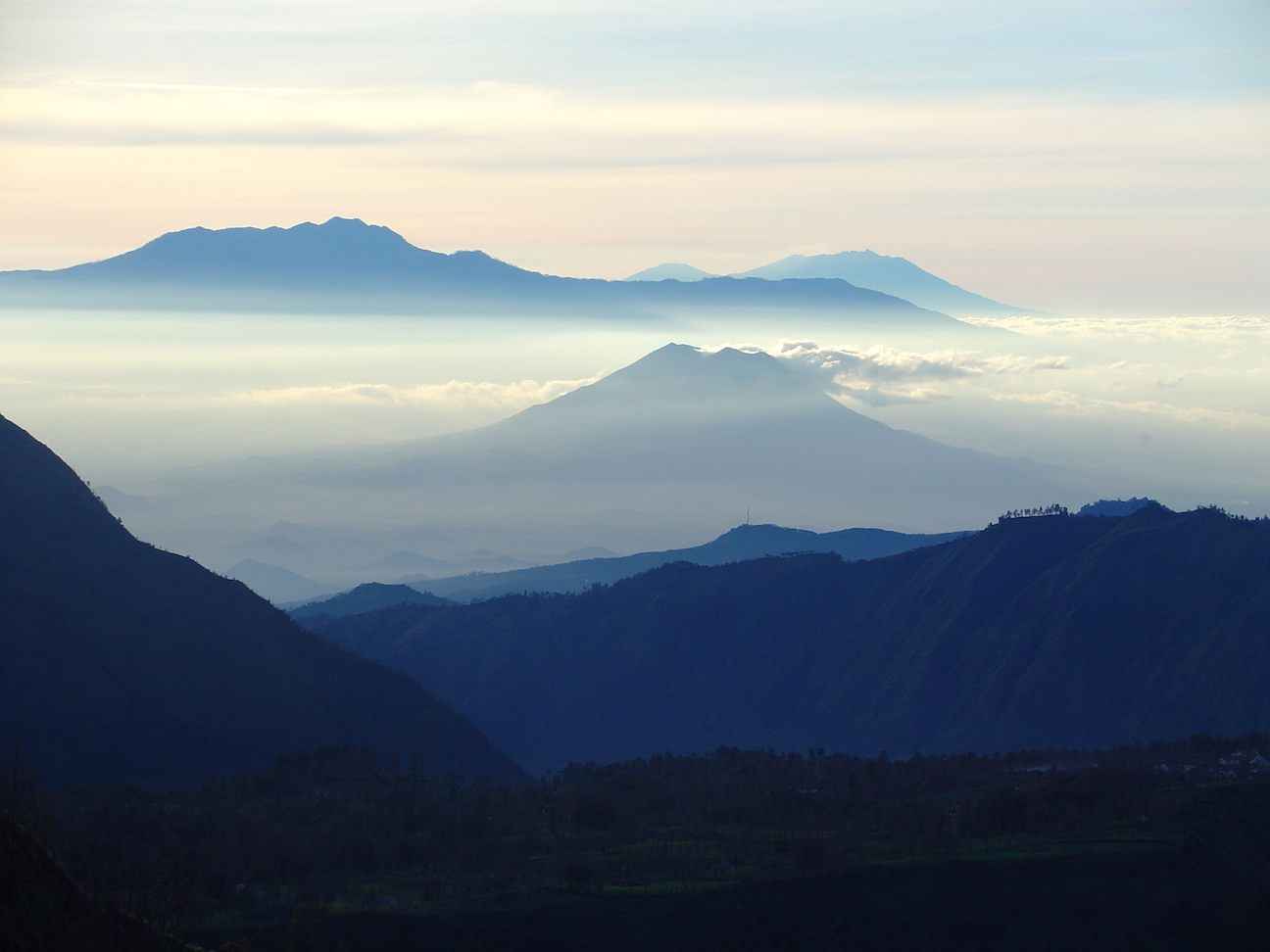
Amazing Mount Bromo
Mount Bromo (Indonesian: Gunung Bromo), is an active volcano and part of the Tengger massif, in East Java, Indonesia. At 2,329 metres (7,641 ft) it is not the highest peak of the massif, but is the most well known. The massif area is one of the most visited tourist attractions in East Java, Indonesia. The volcano belongs to the Bromo Tengger Semeru National Park. The name of Bromo derived from Javanese pronunciation of Brahma, the Hindu creator god.
Mount Bromo sits in the middle of a vast plain called the "Sea of Sand" (Javanese: Segara Wedi or Indonesian: Lautan Pasir), a protected nature reserve since 1919. The typical way to visit Mount Bromo is from the nearby mountain village of Cemoro Lawang. From there it is possible to walk to the volcano in about 45 minutes, but it is also possible to take an organised jeep tour, which includes a stop at the viewpoint on Mount Penanjakan (2,770 m or 9,088 ft) (Indonesian: Gunung Penanjakan). The best views from Mount Bromo to the Sand Sea below and the surrounding volcanoes are at sunrise. The viewpoint on Mount Penanjakan can also be reached on foot in about two hours. From inside the caldera, sulfur is collected by workers.
Depending on the degree of volcanic activity, the Indonesian Centre for Vulcanology and Disaster Hazard Mitigation sometimes issues warnings against visiting Mount Bromo.
Dieng Plateau
Dieng Plateu is a marshy plateau that forms the floor of a caldera complex on the Dieng Volcanic Complex near Wonosobo, Central Java, Indonesia. Referred to as "Dieng" by Indonesians, it sits at 2,000 metres (6,600 ft) above sea level, far from major population centres. The name "Dieng" comes from Di Hyang which means "Abode of the Gods".
Part of General Sudirman's guerilla campaign during the Indonesian War of Independence took place in the area.
The Plateau is the location eight small Hindu temples. Built around 750 CE, they are the oldest known standing stone structures in Java. They are originally thought to have numbered 400 but only eight remain.
Dieng's misty location almost 2000 m above sea level, its poisonous effusions and sulphur-coloured lakes make it a particularly auspicious place for religious tribute. The temples are small shrines built as monuments to the god-ancestors and dedicated to Shiva. The Hindu shrines are miniature cosmic mountains based on plans in Indian religious texts, although the design motifs have little connection to India.The earliest architectural usage of the Javanese demonic masks and marine monsters are exhibited along the niches and doorways of the remaining structures.The Dieng structures were small and relatively plain, but stone architecture developed substantially in only a matter of decades resulting in masterpieces such as the Prambanan complex and Borobudur.
AMAZING MOON
11:17 PM
Amazing Moon Wallpaper, Beautiful Wallpaper, Nature Wallpaper, Unique Wallpaper
No comments
The Moon is the only natural satellite of the Earth, and the fifth largest satellite in the Solar System. It is the largest natural satellite of a planet in the Solar System relative to the size of its primary, having a quarter the diameter of Earth but only 1/81 its mass.[e] The Moon is the second densest satellite after Io, a satellite of Jupiter. It is in synchronous rotation with Earth, always showing the same face with its near side marked by dark volcanic maria that fill between the bright ancient crustal highlands and the prominent impact craters. The Moon is the brightest object in the sky after the Sun, although its surface is actually very dark, with a reflectance similar to that of coal. Its prominence in the sky and its regular cycle of phases have, since ancient times, made the Moon an important cultural influence on language, calendars, art and mythology. The Moon's gravitational influence produces the ocean tides and the minute lengthening of the day. The Moon's current orbital distance, about thirty times the diameter of the Earth, causes it to appear almost the same size in the sky as the Sun, allowing it to cover the Sun nearly precisely in total solar eclipses.
Exotic Auroras
An aurora (plural: aurorae or auroras; from the Latin word aurora, "sunrise") is a natural light display in the sky particularly in the high latitude (Arctic and Antarctic) regions, caused by the collision of energetic charged particles with atoms in the high altitude atmosphere (thermosphere). The charged particles originate in the magnetosphere and solar wind and, on Earth, are directed by the Earth's magnetic field into the atmosphere. Aurora is classified as diffuse or discrete aurora. Most aurorae occur in a band known as the auroral zone,which is typically 3� to 6� in latitudinal extent and at all local times or longitudes. The auroral zone is typically 10� to 20� from the magnetic pole defined by the axis of the Earth's magnetic dipole. During a geomagnetic storm, the auroral zone will expand to lower latitudes. The diffuse aurora is a featureless glow in the sky which may not be visible to the naked eye even on a dark night and defines the extent of the auroral zone. The discrete aurora are sharply defined features within the diffuse aurora which vary in brightness from just barely visible to the naked eye to bright enough to read a newspaper at night. Discrete aurorae are usually observed only in the night sky because they are as bright as the sunlit sky. Aurorae occasionally occur poleward of the auroral zone as diffuse patches or arcs (polar cap arcs), which are generally invisible to the naked eye.
BUNAKEN, The Most Beautiful Diving Island
Bunaken is one of Indonesia's most famous diving and snorkeling areas and it draws visitors from all over the world. In addition to banana-shaped Bunaken Island itself, the 890 km2 of marine national park includes the neighboring islands of Manado Tua (a distinctive cone-shaped extinct volcano), Siladen, Mantehage, Nain, and Nain Kecil.
Some 20,000 local inhabitants make their living from the waters in the Bunaken National Marine Park, and this has inevitably led to some conflicts. By and large though, the co-operation between national and local government authorities, conservation groups, business owners and local communities has been very successful here. This has led many to cite Bunaken as a model example of how Indonesia should be preserving its natural marine treasures.
The park is famed for the clarity of its water (35m visibility is common in the summer dry season), the abundance of coral and fish, and for the precipitous "walls" at some sites. Bunaken Timur, right off the east coast of the island and featuring all of the above, is rated by many as the single best dive site in all Indonesia.
Bunaken has a quite stunning biodiversity including:
- No less than 70 different genera of coral
- Five species of sea turtle
- An extraodinary range of fish - 70% of all fish species that exist in the Indo-Western Pacific Ocean are found here
- White tip and black tip reef-sharks are common
- Wonderful resident dugongs
- Warracuda and tuna make regular appearences from more pelagic waters
- Occasionally saltwater crocodiles
Subscribe to:
Posts (Atom)